• You will need to login or register before you can post a message. If you already have an Agriville account login by clicking the login icon on the top right corner of the page. If you are a new user you will need to Register.

Google Zen Energy South Australia

Collapse
X
Collapse
 
  • Time
  • Show
Clear All
new posts
  • chuckChuck
    Senior Member
    • Dec 2006
    • 13228

    #21
    So Swift Current almost has the same solar resources as Sydney Australia and you guys still think solar doesn't work very well in the southern prairies?

    Utility scale wind is even a better resource.

    And again its not one or the other when it comes to electricity generation sources. You can have many types of sources working together. We already do!

    And you don't need renewables to cover peak demand all the time. Although air conditioning matches well with peak demand in many places.

    Comment

    • shtferbrains
      Senior Member
      • Jun 2017
      • 5369

      #22
      Did you see California cut their credit for what you put into the system from retail price of 30 to 40 cents down to 5 to 8 cents.
      There is no use for that rooftop power going back in at a time when there is surplus
      California has the largest % of home solar due to their past rich programs to encourage it.
      Full retail feed back , no cost instalation programs that gave a large rebate even if you financed on their 20 yr plan.
      The most favorable place in the world for solar has them at 17 to 20% of homes . 42% of the US total is in California.
      But the party is over for the government policy that makes it profitable.

      Why is California the highest power price in the continental USA with the highest % of solar in the most ideal location?
      Last edited by shtferbrains; Jul 5, 2026, 09:29.

      Comment

      • AlbertaFarmer5
        Senior Member
        • Oct 2010
        • 12636

        #23
        Originally posted by shtferbrains View Post
        Why is California the highest power price in the continental USA with the highest % of solar in the most ideal location?
        Probably a coincidence.
        Lots of factors.

        Comment

        • shtferbrains
          Senior Member
          • Jun 2017
          • 5369

          #24
          Primary factor is bad government policy.

          Comment

          • chuckChuck
            Senior Member
            • Dec 2006
            • 13228

            #25
            Utility scale solar and wind are now so low cost you don't need all the subsidies for it to out compete every other source.

            The fuel is free! Sask power will spend a billion per year on coal alone for 25% of our electricity!

            My farm system is roughly 1/2 the price per kwh compared to Sask Power! And that doesn't have the economies of scale that utility scale systems have.

            But Moe and company want to pick winners and losers and customers will be the losers.

            Brad Wall said 50% renewables by 2030! WTF happened as the technology got better and cheaper!


            Canadian solar and wind project costs plummet

            Renewables are now most affordable new generation, as costs are halved

            Jan 28, 2026
            [url]https://www.pembina.org/blog/canadian-solar-wind-project-costs-plummet[/url]

            It’s a happy coincidence of timing: we need a lot more electricity generation, and fast — and we’ve also experienced more than a decade of price reductions in renewable energy.

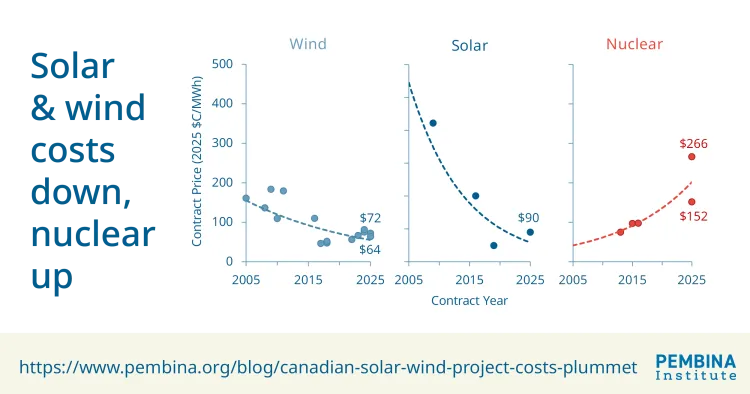
            A look at projects built in Canada shows a clear trend: contracted energy costs from wind and solar have been cut in half over the last 10 years, the period of time during which most projects were built in Canada.

            These wind and solar projects provide concrete, local examples of how costs are coming down as the technology improves and the market matures. Each point in the graph below reflects one or more real projects from signed deals. Altogether, the deals come from procurements in seven provinces across Canada.


            The utilities that operate the electricity systems in most provinces held competitive procurement processes to secure contracts. This gave the market the certainty to grow and build projects that deliver low-cost energy. To top off all that good news, analysts expect that the cost of renewables will continue to drop further by between 25 to 50 per cent over the next decade ([url]https://about.bnef.com/insights/clean-energy/global-cost-of-renewables-to-continue-falling-in-2025-as-china-extends-manufacturing-lead-bloombergnef/[/url]).

            In contrast, the cost of new nuclear projects, including refurbishments, has risen over the same period, so that the energy delivered by nuclear projects contracted over the last couple of years will likely be two to three times the cost of energy from renewables projects contracted in that year. We estimate the Pickering nuclear refurbishment will deliver power at $266 per megawatt-hour (MWh), and the Darlington small modular reactor project will be $152 per MWh; compare that to wind and solar procured in Saskatchewan and B.C. at $64-110 per MWh.

            It's worth noting, too, that the energy from renewables will come along sooner — in the next three to five years — rather than 10 years or more for nuclear projects. It’s important to move quickly as forecasts across the country show a rapid and substantial increase in the need for additional electricity. For example, Ontario expects electricity demand will grow by 75 per cent by 2050 ([url]https://www.ontario.ca/page/energy-generations[/url]), while Alberta expects a 26 to 44 per cent increase ([url]https://www.poweradvisoryllc.com/reports/may-2024-alberta-electricity-newsletter-2024-aeso-long-term-outlook[/url]) between 2024 and 2043. Why the timing of the renewable energy price drops matters


            A decade ago, wind and solar electricity generation were more expensive than other types of generation. But since then, prices have dropped steadily. Now, they’re the lowest-cost form of new electricity generation, according to the grid operators in Alberta ([url]https://www.aeso.ca/assets/Uploads/grid/lto/2024/2024-LTO-Implications-Insights-and-Outcomes.pdf[/url]) and Ontario ([url]https://www.ieso.ca/-/media/Files/IESO/Document-Library/planning-forecasts/apo/Mar2024/Resource-Costs-and-Trends.pdf[/url]), as well as global analysts ([url]https://www.lazard.com/media/uounhon4/lazards-lcoeplus-june-2025.pdf[/url]).

            The timing of this price drop could not have come at a better time. Electricity demand is surging ([url]https://transitionaccelerator.ca/reports/forecasting-canadas-electricity-future/[/url]) to accommodate the electrification of vehicles, home heating and industrial processes, so provinces across Canada are making crucial decisions about how to add more electricity to their systems. Getting more affordable electricity generation onto the grid — fast — underpins the competitiveness of the economy. How electricity users benefit when renewable energy is added to the grid


            Even if solar panels or wind turbines are not on your shopping list, your budget can still benefit from a growing clean energy sector. That’s because when the most affordable forms of new electricity generation — namely solar, wind and battery storage — are added to the electrical grid in your province or territory, they help keep electricity prices low for everybody.

            The biggest cost involved in the life of a wind or solar farm is the upfront capital cost to build the infrastructure. Once they’re built, they run on free fuel (wind and sunshine), unlike natural gas or nuclear plants.

            There are effective ways of making sure this low-cost energy is still available when the sun sets and the wind isn’t blowing. Ontario figured this out when it contracted 1,885 megawatts (MW) of battery storage capacity in its first long-term procurement. Extra wind and solar power is stashed away during peak energy-producing hours and is discharged to the grid when it’s most needed. The province is also harnessing energy savings by working with electricity consumers to reduce demand when necessary, and it’s building transmission lines to move energy from high production to high consumption areas.

            The overall cost reductions of renewable energy over time and the continued low operating costs are the reasons why 93 per cent of new electricity infrastructure ([url]https://www.eia.gov/todayinenergy/detail.php?id=64586[/url]) built in the United States last year was solar, wind and batteries. It’s also why renewable energy overtook coal as the largest source of electricity worldwide in 2025. Where clean energy is being added to the Canadian grid now


            Canadian provinces, having recognized the value of adding more renewables to their electricity mix, are scaling up calls for wind and solar project proposals in 2026. The fact that they’re using competitive auctions to secure the additional electricity means they’re getting the best value for their dollar. Here’s what we’ll be watching this year:
            • Ontario: Over four years, the province is running a technology-agnostic competitive bid process for up to 7,500 MW of new energy and capacity. It’s open to wind and solar developers, as well as energy storage projects and natural gas plants. The first round of results ([url]https://www.ieso.ca/Sector-Participants/Resource-Acquisition-and-Contracts/Long-Term-2-RFP[/url]) are expected in April.
            • Quebec:Hydro-Québec announced plans last year to develop 10,000 MW of wind and 3,000 MW of solar energy by 2035. The first call for tenders ([url]https://www.hydroquebec.com/achats-electricite-quebec/appels-propositions/2025-01.html[/url]) for 300 MW of solar energy is opening in April.
            • British Columbia: BC Hydro launched a bid process in 2025 to acquire up to 5,000 gigawatt hours per year of new clean or renewable energy projects. For comparison, this is roughly equivalent to either 1,600 MW of wind or 2,500 MW of solar. BC Hydro got 14 proposals totalling more than 9,100 gigawatt hours per year, ([url]https://news.gov.bc.ca/releases/2026ECS0003-000056[/url]) nearly double the targeted amount, and final results are expected in the coming months.
            • Manitoba: Manitoba Hydro is procuring 600 MW of wind power this year, with the official request for proposals ([url]https://www.hydro.mb.ca/corporate/call-for-wind-power/[/url]) coming out in March.
            • The territories do not have centralized renewable energy requests for proposals. They’re typically smaller community-oriented projects, funding programs, and utility procurements rather than large multihundred-MW auctions. Our recent report, Restoring the Flow ([url]https://www.pembina.org/pub/restoring-flow[/url]), explores the status of policies supporting Indigenous-led clean energy in remote communities.

            However, a couple of provinces are choosing to go a different direction with new energy needs and are missing out on the opportunities of low-cost renewable energy:
            • Alberta: Until recently, Alberta led the country in renewable energy deployment. However, after a series of major policy changes, the market is stalling, as our report from last year highlights ([url]https://www.pembina.org/pub/down-not-out[/url]).
            • Saskatchewan: The Government of Saskatchewan decided in the middle of last year to extend its coal fleet to power its grid until nuclear plants come online sometime later in the century. Although it is also procuring some renewable energy, we believe the decision to extend coal is going in the wrong direction ([url]https://www.pembina.org/blog/saskatchewan-going-wrong-direction-coal[/url]).

            The provincial and territorial governments with the foresight to take advantage of the low-cost electricity available from wind and solar can do so by planning their systems around a modernized grid. This means harnessing the latest technology — including interprovincial interties, demand-side measures and long-duration energy storage — to manage their energy in a way that delivers affordable and reliable electricity as demand grows.

            2026 will be another exciting year for clean energy in Canada as federal, provincial and territorial governments adjust to the new reality of low-cost renewable energy and make crucial decisions about the future of our energy supply.

            Comment

            • shtferbrains
              Senior Member
              • Jun 2017
              • 5369

              #26
              Why China is building all type of power generation when not burdened by generations of bad government policy that picked winners and created losers.
              Just basic build and put into production one after another with efficiencies not seen here in generations.

              Nuclear: ~0.05–0.07 CAD/kWh LCOE. Excellent baseload with low balancing costs and high reliability.


              Coal: ~0.08–0.12 CAD/kWh. Flexible but burdened by fuel volatility, carbon costs, and declining role.


              Renewables (wind/solar): Direct ~0.04–0.08 CAD/kWh; system (balancing/storage) pushes effective cost to 0.06–0.12+ CAD/kWh. Lowest marginal but intermittent


              Natural Gas (CCGT): ~0.06–0.10 CAD/kWh. Competitive for flexible/peaking power; lower capital than nuclear but fuel price sensitive and emits CO₂. Increasing role for grid balancing alongside renewables.

              It wasn't long ago that western economies outperformed communist economies by a wide margin. Back when we built things like Nuclear plants.
              Soviet / West cold war.
              Now when we are about to build a pipeline, people think that budgeting higher that the last total government boondoggle won't be enough to make it happen. The on site material like pipe, pump stations, and labor are almost a minor part of the cost.
              But nowhere will you see that broken out.​
              Last edited by shtferbrains; Jul 6, 2026, 20:47.

              Comment

              • Landdownunder
                Senior Member
                • Mar 2021
                • 1909

                #27
                All sorts of skullduggery goes on which is hard to prove.
                Solar system A is worth x in china. Same solar system A in Australia is about 30% more then solar rebate matches the 30% increase which is possibly not paid either way solar company get paid cost. Nil all draw who knows so cynically it looks like govt is lowering cost? Who knows subsidies were real 10 years ago no idea know.

                Pea and thimble stuff

                Comment

                • chuckChuck
                  Senior Member
                  • Dec 2006
                  • 13228

                  #28
                  Shite for brains where did you get the LCOE figures from because they are not accurate for nuclear, coal or gas.

                  Renewables are killing it with the lowest prices by far in Australia!

                  The experts at Australia’s leading energy and science bodies, including the Australian Energy Regulator, ([url]http://www.aer.gov.au/system/files/2025-06/Q1%202025%20Wholesale%20quarterly%20report.pdf[/url])Australian Energy Market Operator ([url]https://www.aemo.com.au/-/media/files/major-publications/isp/draft-2026/draft-2026-integrated-system-plan.pdf?rev=8e38a5150ec2474791ee573a9981f07c&sc_l[/url] ang=en) (AEMO), Australian Energy Market Commission ([url]https://www.aemc.gov.au/market-reviews-advice/residential-electricity-price-trends-2025[/url]) and CSIRO ([url]https://www.csiro.au/en/research/technology-space/energy/electricity-transition/gencost[/url]), have crunched the numbers to determine the best, cheapest form of electricity for Australia. Their analysis consistently shows that renewable power, backed by storage like pumped hydro and batteries, is the most cost-effective way to keep reliably powering Australian homes and businesses.

                  Already, nearly 45% of Australia’s electricity ([url]https://explore.openelectricity.org.au/energy/nem/?range=all-12-mth-rolling&interval=half-year&view=discrete-time&group=Detailed[/url]) comes from solar, wind, hydro power and batteries – and this is rapidly increasing. At the same time, the share of fossil fuels in our grid is falling. As Australia’s coal-fired power stations age they are only operating at around 65% of their full capacit ([url]https://www.climatecouncil.org.au/resources/lights-out-ageing-coal-and-summer-blackouts/[/url]) and are frequently breaking down. Coal outages have been a primary driver of power outage warnings in recent years, as well as contributing to some of the most severe price spikes. Australia’s energy market operator is preparing for two-thirds of the remaining coal fleet to close by 2035, with all due to retire by 2049.

                  As coal generators reach their end-of-life, there is no question that we must bring new generation online to power our homes and businesses. But what is the most cost-effective way to reliably power our homes and businesses past the end of coal?

                  The clear answer is: renewables and storage. ([url]https://www.climatecouncil.org.au/resources/power-games-whos-driving-high-power-bills/[/url]) How much do renewable energy projects cost?

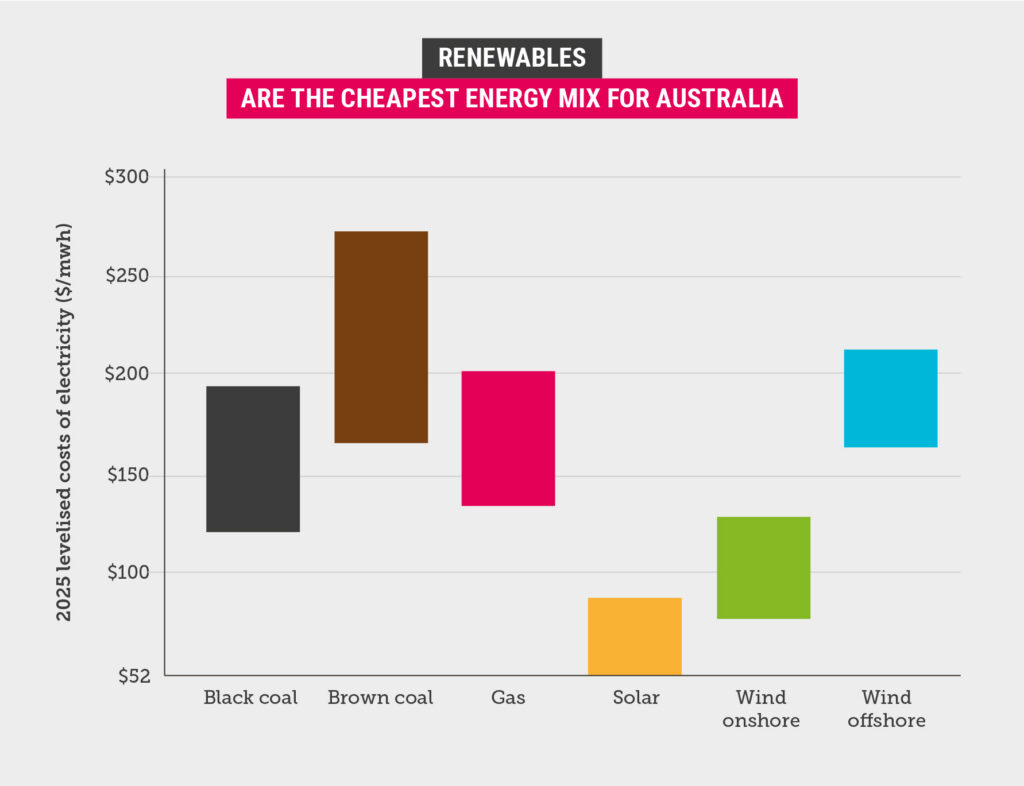
                  CSIRO’s draft 2025-26 GenCost Report ([url]https://www.csiro.au/en/research/technology-space/energy/Electricity-transition/GenCost[/url]) found for the eighth year in a row that a renewable power system is the lowest-cost option for Australia. Solar is by far the lowest-cost technology, onshore wind is cheaper than coal and gas, and battery costs are continuing to fall. Both can be rapidly deployed. Meanwhile, the costs of coal and gas generation projects have increased significantly, and waiting lists for new gas turbines have blown out into the 2030s. Large-scale nuclear costs three times as much as a wind project (per kilowatt-hour) while small-scale nuclear would cost nine times as much.
                  CSIRO has confirmed for eight years in a row that solar and onshore wind form the basis for Australia’s least cost generation mix. Source: CSIRO 2025: Draft 2025-26 GenCost Report ([url]https://www.csiro.au/en/news/all/news/2025/december/consultation-opens-on-the-draft-gencost-2025-2026-report[/url])

                  Comment

                  • shtferbrains
                    Senior Member
                    • Jun 2017
                    • 5369

                    #29
                    China's costs without all the accumulated government policy baggage that factor in in the western world.
                    Russia is slightly higher but closer to China than us.
                    Look it up.
                    The reason solar has a big advantage here is accumulated policy / regulatory drag on the others.
                    And getting worse instead of better.

                    Comment

                    • Landdownunder
                      Senior Member
                      • Mar 2021
                      • 1909

                      #30
                      Probably delete wind this thread up.
                      Hardly making news here now "just another solar company goes belly up"
                      Calls for more govt support for companies but raises questions why do we have most expensive electricity in Australia and about 5th in the world and companies falling over?
                      And quality solar/battery systems aint cheap nowadays.

                      Oddly never hear of wind farms going broke.

                      Good rational discussion as always all.

                      Comment

                      • Reply to this Thread
                      • Return to Topic List
                      Working...