
So what about the wells that don't have enough gas to be viable to store or transport but just enough to be an occasional nuisance. That would shut down several plays.
-
-
If you dont have a plan to collect,consolidate and use gas and get it to market then your planning and execution is inadequate.
The atmosphere is a public space and you shouldn't get to flare gas or dump your H2S in the atmosphere when better options exist.
If you don't make enough money to do it right then you you don't have a viable business plan.
Which when you consider the cost of reclamation is also being dumped on taxpayers and landowners that is a big sign the industry is not being responsible. Gas flaring is another sign.
If marginal wells with gas can't cover their costs shut them down.
Comment
-
Rather simplistic in my opinion. Shutting in a lot of oil for inconsequential amounts of gas.
Next will be livestock operations?
Absolute requirements kill things absolutely.
Zero tolerance limits.
No more herbicides either.Comment
-
The oil companies are wasting usable gas and venting methane and H2S into the atmosphere willy nilly.
None of that is inconsequential. Again you are in denial BP! And don't seem to know the extent of the problem!
The oil companies aren't even following existing regulations. And there is inadequate enforcement.
"Flaring and methane leaks from the oil and gas sector are major contributors to greenhouse gas emissions in Western Canada, particularly in Alberta and British Columbia. The industry accounts for roughly 40-43% of Canada's total methane emissions. While regulatory bodies have set targets, recent studies suggest that actual emissions from flaring and leaks are significantly higher than official reports, with some estimates being 50% higher.
Key Aspects of Methane Emissions in Western Canada- Major Sources: The oil and gas sector (upstream oil and gas, field processing) is the largest industrial source of methane in Canada. Key sources include leaky equipment (valves, pumps), pneumatic devices, storage tanks, and venting from inactive or abandoned wells.
- The "Underestimation" Problem: Independent research using satellite data and aircraft has shown that methane leaks in Alberta's oilpatch are significantly underestimated by industry self-reporting. For instance, one study found that methane emissions from Alberta's oil and gas facilities are on average 50% higher than what is officially reported.
- Solution Gas Flaring: Alberta has experienced a rise in solution gas flaring, exceeding its own regulatory limits for 2023 and 2024. In 2023, the province reported over 1.3 billion cubic meters in flares, up from 753 million cubic meters in 2022, exceeding the 670 million cubic meter cap. Reports indicate that Alberta has removed its cap on solution gas flaring, leading to concerns from environmental groups about increasing, unregulated, or poorly managed emissions.
- Venting and Leaks: Beyond flaring, unintentional "fugitive" leaks occur, as well as intentional venting (releasing methane directly into the atmosphere). These leaks occur across pipelines, compressors, and thousands of abandoned wellbores."
Comment
-
Moving Forward on Methane
How Alberta can demonstrate renewed leadership on oil and gas methane emissions
[url]https://www.pembina.org/pub/moving-forward-methane[/url]
Download PDF ([url]https://www.pembina.org/sites/default/files/2026-03/Methane-Key-Findings_Final_20260316_0.pdf[/url])
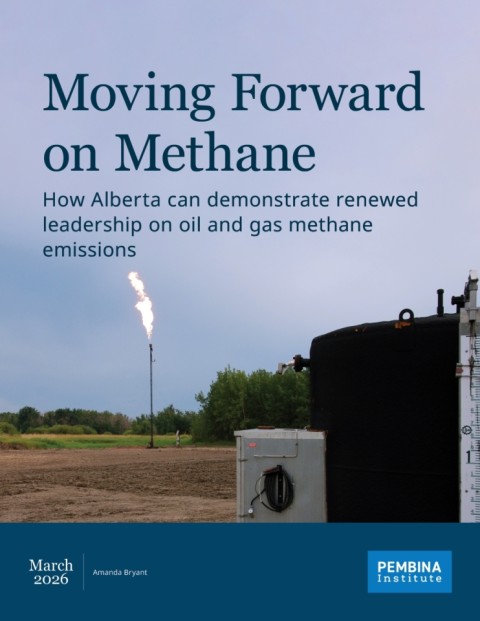
These documents are a new technical analysis and a plain language summary by the Pembina Institute that identify data and regulatory gaps relating to Alberta’s oil and gas methane emissions and provides recommendations. The objective is to demonstrate how Alberta’s regulations, reporting data, and emissions estimates can be strengthened to better track progress, evaluate compliance, and support deeper reductions.
We reviewed independent measurement studies, provincial and federal estimates, and industry-reported data, including from surveys done under the Alternative Fugitive Emissions Management Program. Our detailed findings and methodology can be found in the supplementary technical backgrounder. Key findings
Our analysis revealed four critical gaps that must be closed if Alberta is to regain its status as a leader on methane emissions:- Emissions data: Alberta is underestimating emissions. The federal greenhouse gas inventory, which incorporates independent measurements, estimates that Alberta’s oil and gas methane emissions are almost twice the amount indicated by Alberta’s methane model, which is based primarily on industry self-reporting. This means that the province’s claim to have met its target of reducing methane emissions 45% (from 2014 levels) by 2023, three years ahead of schedule, is not credible.
- Venting: A significant amount of venting is occurring above the province’s limit on vent volumes at oil and gas sites. Most facilities vent methane at volumes below the threshold above which metering is required, allowing them to estimate their vent volumes using flawed methods. This partly explains why measurement-informed estimates of vent volumes are five times higher than reported vent volumes.
- Separator buildings: Pneumatic controllers and pumps are a significant and under-regulated source of methane emissions in separator buildings, and the quality of reported data is poor.
- Solution gas flaring: Solution gas flaring has more than doubled in Alberta since 2019, and the removal of Alberta’s solution gas flaring limit in 2025 means policy is lacking to prevent further increases. Since a good deal of solution gas flaring is routine flaring, the elimination of the limit also puts Alberta out of step with international best practices that ban routine flaring and threatens the health of local communities.
To close these gaps and regain its leadership status, we recommend Alberta do the following:- Improve the province’s ability to credibly track and demonstrate reductions by basing estimates of oil and gas methane emissions on measurement data.
- Require top-down methods to measure methane emissions from oil and gas facilities (vehicle-based systems, aircraft, drones, or continuous monitors), in addition to the close-range methods commonly used in leak detection and repair programs, and integrate the resulting data into reporting.
- Eliminate routine venting by 2030.
- Phase out emitting pneumatics by 2030 or sooner.
- Engage diverse interest holders, including academic experts, to co-develop and improve measurement and reporting frameworks and requirements to enhance the quality and accuracy of reported data.
- Eliminate routine flaring.
Comment
-
Google says there's enough flaring worldwide. Can't legislate the 4 big boys from Canada. AB did exceed it's "limits" in '24.
I encourage anyone who's in the industry to comment.
I am not and Chuck clearly isn't in any industry at all.
All I know is, my boots were on a 400bpd lease this winter and the flaring amount would not have paid for fk all.
H2S is still H2S after it's burnt? You'll have to explain that one.
One of the safest oil production areas. Price doubled since the war. You can imagine what happened to costs.
Like agriculture, the Chucks some of the biggest risks.Comment
-
"If you don't make enough money to do it right then you don't have a viable business plan"
These words from Chuck are priceless.
I would start by applying them to supply management.
Any other ideas?Comment
-
But BP your boots were on a 400 barrels per day lease this winter and you think the oil company didn't have enough revenue to stop flaring and fix any leaks? LOL
That explains it then! That's at least $28000 USD per day at $70 oil and $40,000USD at today's prices per day.
And it still can't be done?
Comment
-
I happen to know the owners and the costs and risks. You are suggesting a legislated mandate of zero, not a sales funded capture.
Come back with real world info. Call a friend. Better yet, buy in.
Comment
-
And I'm fascinated by his NDP math. Explains a lot.Comment

- Reply to this Thread
- Return to Topic List
Comment